
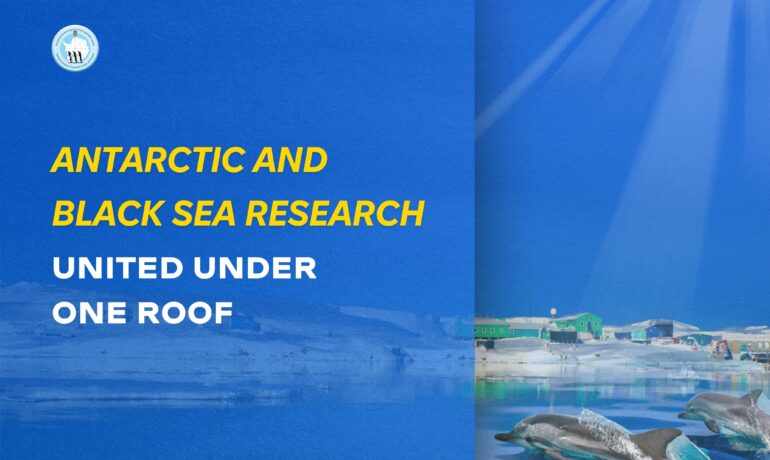
A significant development for marine and Antarctic research has taken place in Ukraine: two scientific institutions are being merged. The relevant decision was adopted by the Government of Ukraine on 6 May.
The Ukrainian Scientific Center for Ecology of the Sea (UkrSCES), the institution responsible for marine monitoring and the study of the Black Sea, has become part of the National Antarctic Scientific Centre (NASC).
This means that the scientific potential of marine, oceanographic and Antarctic research is now being brought together within a single organisation. For the time being, it is the NASC, although the institution’s name will be changed accordingly in due course.
Why is this important?
Bringing leading oceanographers together under one organisational structure
Scientists studying the Black Sea have been taking part in Antarctic expeditions for many years. Under the conditions of Russia’s full-scale invasion and restricted access to the Black Sea, research in Antarctica has become one of the few opportunities for these scientists to continue their scientific careers in Ukraine. For the country, this is a chance to preserve a unique and relatively small pool of marine research expertise.
Making more effective use of research infrastructure
A unified Ukrainian research fleet will be established. It will include the ice class vessel Noosfera, which has successfully carried out Antarctic missions for five consecutive years, as well as other research vessels. These include hydrobiological and hydrographic vessels intended to support marine research and regular environmental monitoring.
Bringing the research fleet under unified management will enable more efficient use of different types of equipment for research in both distant Antarctica and the Black Sea (as soon as access becomes possible), as well as the Sea of Azov (once access is restored).
With its successful experience in operating a research vessel, the NASC will serve as an operational centre for organising comprehensive marine research. This will also help optimise public spending on research fleet maintenance and the organisation and implementation of marine expeditions.
Strengthening international cooperation
The aim is to expand research in the Black Sea and the World Ocean, drawing on the NASC’s experience and established partnerships in Antarctica.
Advancing scientific innovation across different parts of the world
Scientific methods will be tested in both directions: from the Black Sea to Antarctica and vice versa. For example, Ukrainian researchers first tested the method of assessing biodiversity through environmental DNA (eDNA) in the Black Sea, then applied it in the Southern Ocean. Now, drawing on their Antarctic experience, they can further refine and improve its application back home.
There are many examples of this kind of two-way exchange of research methods between ocean regions, and the merger of the institutions will make this process even easier.
Integrating polar and marine research within a single institution is an established and successful international practice. For example, the Alfred Wegener Institute for Polar and Marine Research in Germany is among the world’s top five institutions in ocean and polar research.
We hope that Ukrainian science will achieve similar success in the years to come.