

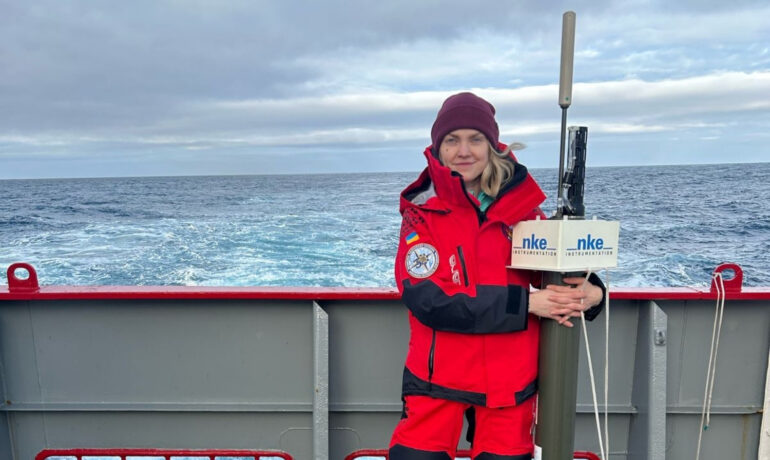
Last March, Ukrainian scientists launched a new oceanographic study by deploying six Argo buoys in the Southern Ocean.
These are autonomous stations that descend to a set depth (in our case, 1.5 km) and drift with the currents. Every 10 days, the buoys descend to their maximum depth, and as they rise, they record temperature and electrical conductivity values (used to calculate salinity) every meter. Once they resurface, they have only 20 minutes to transmit the data to a satellite.
But what if there’s ice above the buoy? Temperature safety mechanisms have been installed for Antarctic conditions: the buoys do not surface at temperatures below −1.75°C to avoid colliding with ice or an iceberg.
As the scientists had planned, all the buoys are continuously drifting in the Bransfield Strait—a dynamic and under-researched region. There, the colder and fresher waters of the Weddell Sea mix with the saltier and warmer waters of the western part of the Antarctic Peninsula.
However, one of the buoys did not send any data for several months—and there was great joy when it resurfaced and transmitted the accumulated information. Most likely, it had been drifting under the ice and had no safe place to resurface.
This is the first study using argon buoys conducted by Ukraine, and at the same time, the first year-round study of this region of Antarctica. It is particularly valuable that the study collected regular data during the Antarctic winter. In total, over the course of more than a year, researchers received 428 reports from the buoys, and they continue to come.
What did this data reveal? It provided a new perspective on the seasonal variability of seawater: the formation of seasonal surface water, the stratification and densification of deeper layers, as well as the identification of layers that remain stable throughout the year.
“If we compare water masses to a garden, then, in addition to the green summer, we have finally seen other seasons: how leaves sprout from buds, turn yellow, and fall off,” notes Natalia Dikul, an oceanographer at the National Antarctic Scientific Centre.
Why is this important? The upwelling of deep, nutrient-rich waters to the surface promotes the growth of phytoplankton, which forms the basis of food chains (krill, fish, birds, seals). At the same time, the inflow of warm deep water accelerates the melting of ice shelves. For climatology, these data reveal new insights into heat transport by the circumpolar Antarctic current and its impact on glaciers.
The research is being conducted as part of the OCEAN:ICE project under the EU’s Horizon Europe program and is funded by the EU in collaboration with UKRI (the UK’s Department for Research and Innovation).