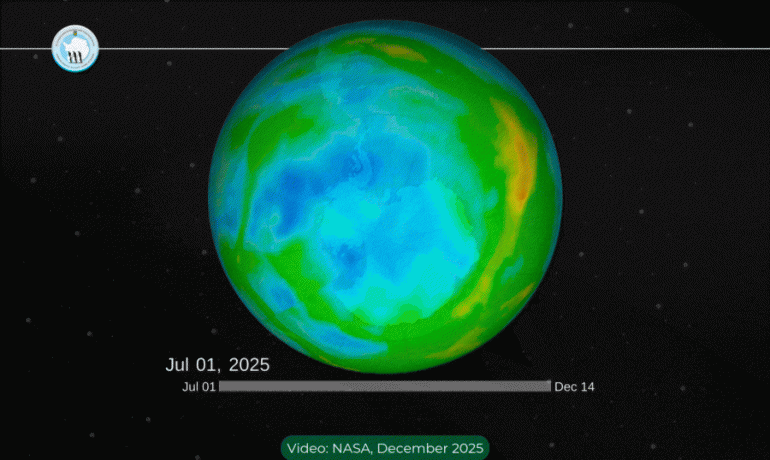

This year, the ozone hole over Antarctica closed not only earlier than expected, but also the earliest since 2019. It closed on 1 December. Data from the Copernicus Atmosphere Monitoring Service (CAMS), NASA, and our Vernadsky base confirm this conclusion.
Actually, the ozone hole phenomenon was first discovered at this station, when it still belonged to Britain and was called Faraday. It is a significant decrease in stratospheric ozone concentration (below 220 Dobson units) above Antarctica during a specific period, mainly from August to November.
Ukrainian polar explorers at Vernadsky base constantly monitor ozone concentrations, continuing one of the longest data series started by the British.
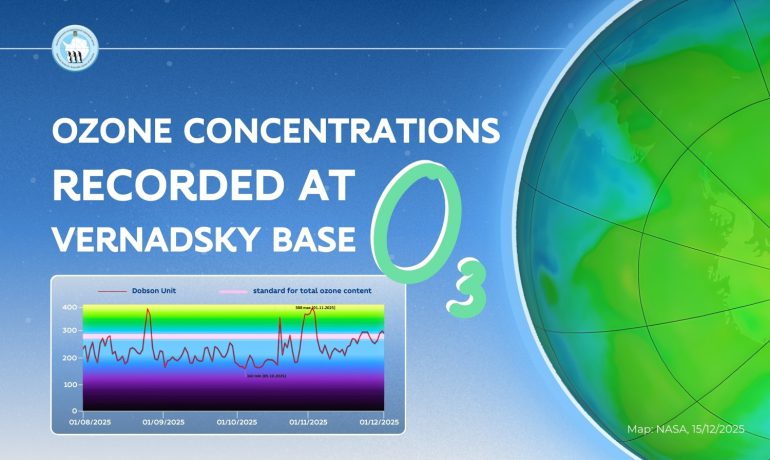
This year, the scientists recorded the first ozone concentrations below 220 DU on 3 August. A stable return to normal (270-290 DU) was observed from 17 November.
During this period, 81% of days had below-normal values, with a minimum of 160 DU, which is higher than in previous years.
See the graph for how the dynamics of ozone concentrations recorded at Vernadsky changed.
These data confirm the general trend recorded by CAMS and NASA Ozone Watch. It can be seen in the NASA video series.
The size of the ozone hole varies from year to year. Since the early 1980s, its area has been growing rapidly, lasting longer and longer, and ozone has been depleted accordingly. In the 2000s, this negative trend stopped, and the ozone layer began to recover gradually. This is attributed to the 1987 global ban on the release of ozone-depleting substances into the atmosphere.
Over the following decades, the size of the hole fluctuated somewhat because stratospheric ozone is affected not only by human activities but also by various natural factors, such as solar cycles, volcanic activity, and ocean conditions.
CAMS notes that the 2025 ozone hole was relatively small for the second year in a row compared to the large, persistent ozone holes of 2020-2023, and that it had higher ozone concentrations.
This gives hope that the ozone hole is gradually ‘closing’.